From Worker to Thinker: AI and the Great Decoupling of Labor
The most valuable company in the world today provides infrastructure for artificial intelligence. It did not build that position by hiring millions of workers. NVIDIA earned $215 billion in revenue last year with roughly 36,000 employees.[7] For comparison, General Motors employs over 160,000 people to generate about $180 billion. That ratio is not a footnote — it is an announcement.
Capital has found a new body. And for the first time in modern economic history, that body does not need human labor in the same proportion to grow.
Some call this the great decoupling of our generation: not the geopolitical split between the US and China, not supply-chain fragmentation, but the quiet separation between capital and labor. I want to think through what that means — not to arrive at despair, but because I think it is one of the most important questions anyone entering the workforce today should take seriously.
The Bargain That Made the Modern World
Let me start with something almost everyone used to take for granted.
For most of the twentieth century, a growing company was also a hiring company. A factory needed workers. A bank needed tellers and analysts and compliance officers. A consulting firm needed armies of junior associates to collect data, build slides, and prepare first drafts. Growth pulled employment behind it like train cars behind an engine.
This was not a perfectly fair system — workers could be underpaid, managers could exploit, industrial work could be dangerous. But it was mutually dependent. Capital needed labor to scale, and labor needed capital to turn its effort into income.
The social contract that emerged went something like this:
Capital received profit. Labor received income, identity, and a path into the middle class.
Work was not just economic. It was moral. You built skills, you contributed something, and in return you got wages, stability, and a sense of place in the world. The American Dream, in its most basic form, was built on this logic.
AI disrupts this because it gives capital a new way to scale — one that does not require nearly as much human labor as before.
Capital Has Found a New Body
In the old economy, capital’s body was visible: factories, machines, warehouses, offices, inventory. You could walk through it, count the workers, feel its scale.
In the AI economy, capital is acquiring a different body: data centers, GPU clusters, large language models, cloud platforms, software agents, and autonomous workflows. You cannot walk through it the same way. But it generates enormous value — and with a very different ratio of capital to human labor.
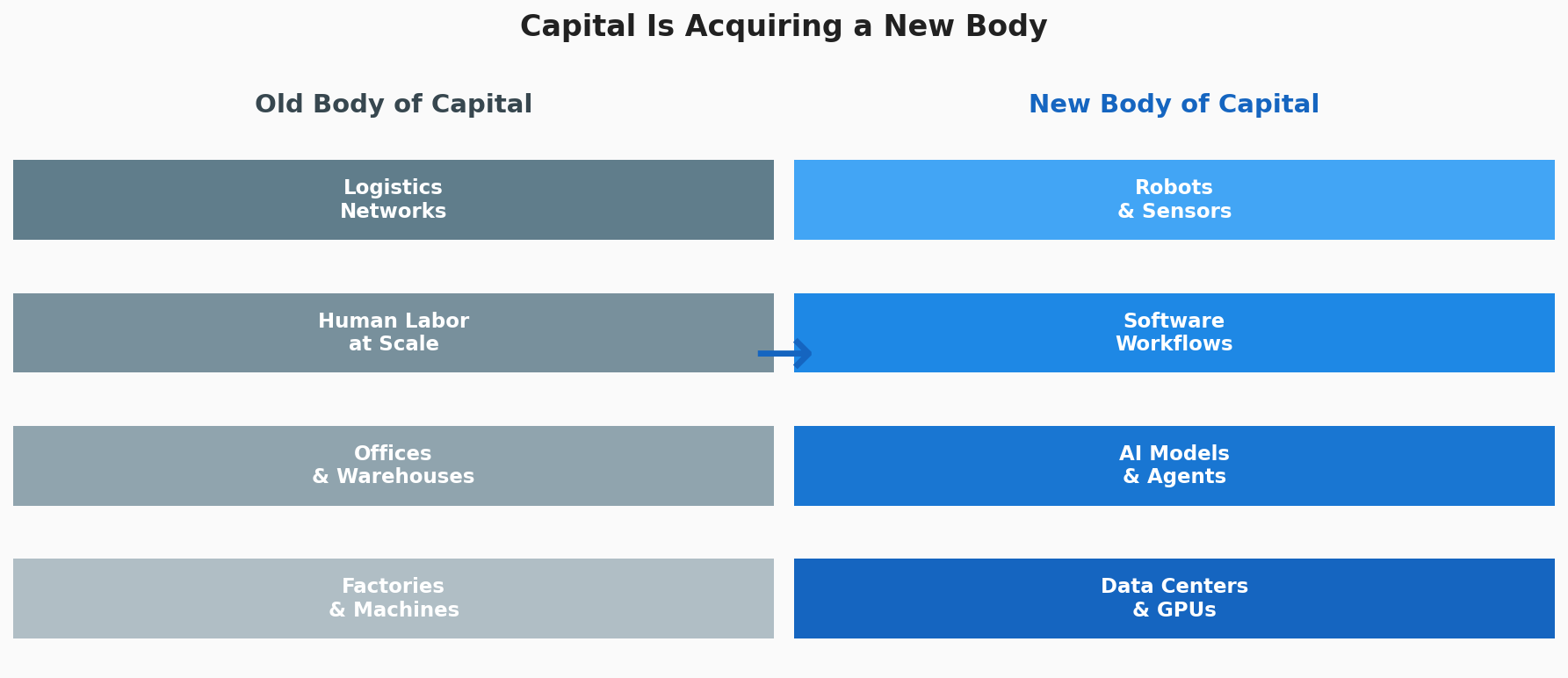
Tech giants Amazon, Microsoft, Google, and Meta collectively poured an estimated $320 billion into AI infrastructure in 2025 alone. That capital is not going into factories that will hire assembly workers. It is going into infrastructure that, once built, scales globally with relatively little additional human labor per unit of output.
That is the heart of the decoupling. A modern AI company can generate enormous revenue with a concentrated group of highly specialized workers, massive capital spending, and software that spreads without proportional headcount. The NVIDIA arithmetic is not an anomaly — it is a preview of where things are heading.
AI Enters the Mental World First — and That Is Why It Feels Different
Here is the part that I think catches people off guard, including some of my own students.
Earlier waves of automation mostly threatened physical labor — robots entered factories, machines entered warehouses. White-collar workers had a quiet confidence that their work was different. It required language, judgment, creativity, professional knowledge. Surely those things were harder to automate.
Generative AI begins from the other side entirely. It enters language, code, analysis, writing, summarization, design drafts, data cleaning, customer service, compliance review, and financial research. It does not start in the factory. It starts in the office.
Anthropic’s labor-market research — the most careful empirical study I have seen on this — introduces a measure that distinguishes between what AI can theoretically do and what it is already doing in professional settings today.[2] The findings are striking. The occupations with the highest observed exposure are not the ones we expect from earlier automation waves. They include computer programmers, customer service representatives, data entry specialists, financial analysts, market researchers, and medical records clerks.
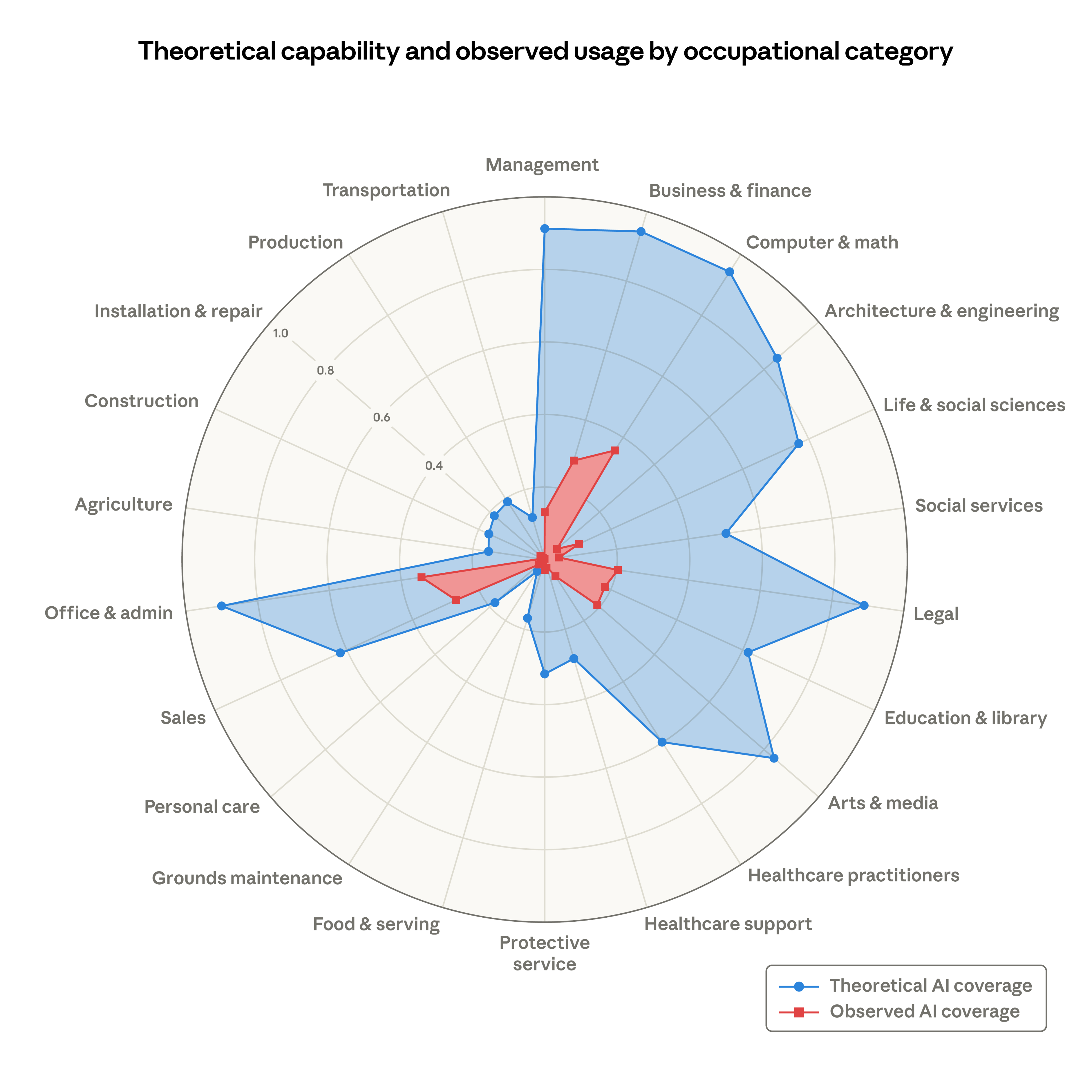
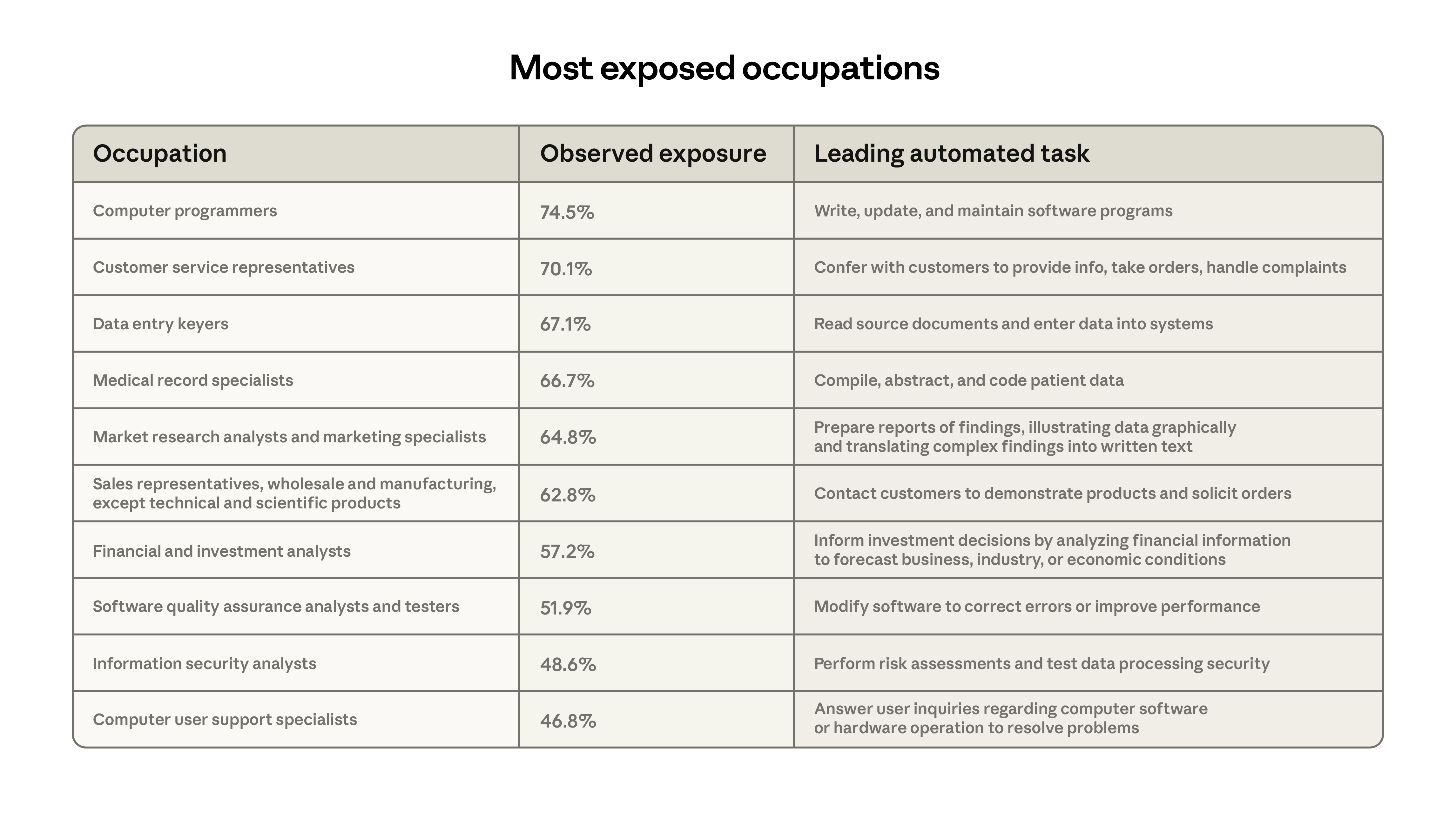
Notice that the most exposed occupations sit at the heart of what we call “professional work.” The first wave of AI disruption is not physical automation — it is cognitive automation. And that changes who feels it first.
The most important point is not that all these jobs disappear — the evidence, as I will show, is more nuanced than that. It is that the task structure of these jobs is changing. A job may remain while the price of many tasks inside it falls sharply. And that changes the economics of who is valuable, and how you develop into a professional over time.
Robots Extend the Same Shift Into the Physical World
If AI begins with cognitive labor, robotics extends the same logic into the physical world — faster than most people realize.
The International Federation of Robotics reported 542,000 industrial robots installed worldwide in 2024. China alone installed 295,000 units — roughly 54% of global installations.[5] That is not a rounding error. It is a structural shift in what factories look like and who they employ.
The deeper transformation comes when AI models and robots work together: models providing perception, planning, and decision support; robots providing physical execution. What emerges is a production architecture that no longer requires the same volume of human labor at either the cognitive or physical end of the value chain.
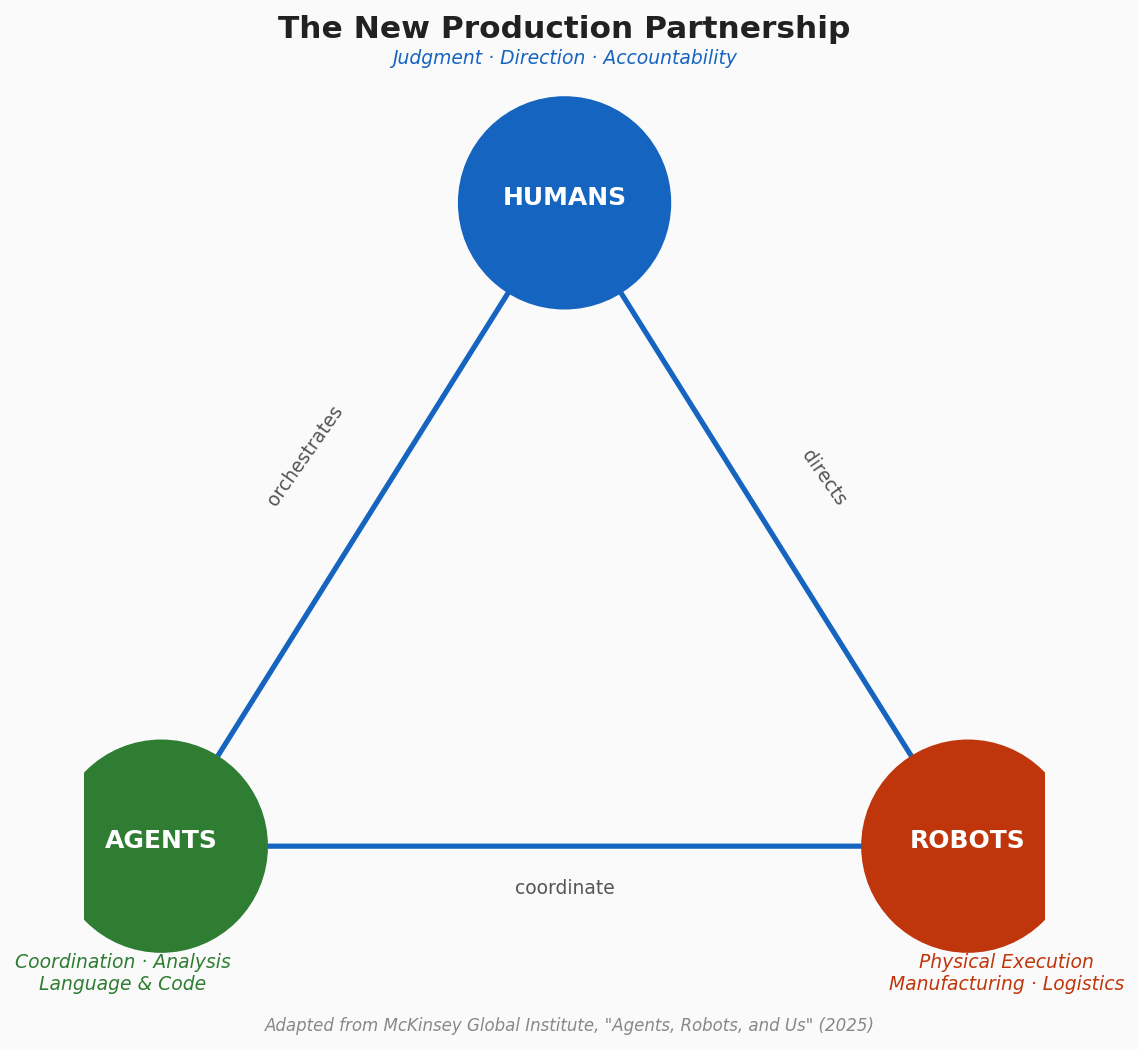
McKinsey estimates that AI-powered agents and robots could unlock about $2.9 trillion in annual US economic value by 2030.[4] And here is what I find genuinely encouraging about that number: it represents enormous productive capacity that, if distributed well, could make most people significantly better off. Whether it does is a design question, not a destiny.
Why Investors Cheer and Workers Worry About the Same News
Now step back and look at the whole picture from above — the AI absorbing cognitive tasks, the robots absorbing physical tasks, the data centers replacing what was once done by large teams. Who is excited about all of this?
Investors are. And not without reason.
Capital markets reward efficiency, scalability, and margin expansion. When Klarna announced that its AI assistant handled the equivalent work of 700 full-time agents in its first month — doing two-thirds of all customer-service chats and generating an estimated $40 million profit improvement[8] — investors cheered. When Amazon’s CEO Andy Jassy wrote that generative AI and agents would, over time, reduce the company’s total corporate workforce as it gains efficiency,[9] that was not alarming to shareholders. It was the business model working as intended.
The worker and the investor are not watching different events. They are watching the same event from different seats and having completely different reactions.
| What a firm announces | Investor reaction | Worker reaction |
|---|---|---|
| AI assistant replaces 700 agents | Margin improvement — buy | 700 jobs gone — worry |
| AI reduces need for junior analysts | Leaner org structure — efficient | Fewer entry-level roles — harder to break in |
| Agents coordinate workflows across teams | Scalability without headcount — great | Middle-management layers become thinner |
| Generative AI cuts documentation time | Productivity gain — upside | Fewer billable hours — downward pressure on fees |
This is what the decoupling looks like in practice. It is not a sinister conspiracy. It is the rational behavior of a system optimized for returns on capital. And the challenge for society is to figure out how to share the gains — because the gains are real.
But Here Is What the Data Actually Shows — and It Is More Hopeful Than the Headlines
I want to be careful not to let this become a story of inevitable doom. The data is more complicated — and more genuinely interesting — than the doom narrative suggests.
Yes, AI adoption is rising fast: 78% of organizations used AI in 2024, up from 55% in 2023, according to Stanford’s AI Index.[3] Yes, there are firm-level examples of clear labor substitution. Yes, senior executives are openly planning for smaller workforces.
But here is what the macro evidence says: a 2026 Federal Reserve note finds no evidence that firms or industries with higher AI adoption have lower job postings overall.[10] The New York Fed similarly cautions that AI exposure does not automatically translate into reduced hiring or layoffs at the occupation level — more firms in their sample actually reported retraining workers in AI-exposed roles than reducing hiring.[11]
A recent working paper by Wang, Wei, and Wang is even more revealing.[12] They find that firms are adjusting to AI through two mechanisms simultaneously: some do reduce hiring in exposed roles, but many redesign the job from the inside — changing what the work involves rather than eliminating it. For junior positions, both mechanisms are at play.
This is the honest picture. We are not in a mass unemployment crisis. We are in a period of task repricing, organizational redesign, and career-ladder disruption. The danger is not that half of all jobs disappear tomorrow. It is slower and more insidious: fewer junior positions in certain fields, thinner middle layers, job descriptions quietly rewritten around AI supervision, and a generation of young people who find the entry rungs of the career ladder already occupied by a machine.
That is worth solving for — which is exactly what makes it a design challenge rather than a verdict.
The Apprenticeship Problem Nobody Talks About Enough
This is the part I find most personal — and most urgent — as someone who teaches.
In almost every profession, junior work is not glamorous. Young people collect data, clean spreadsheets, summarize filings, write first drafts, reconcile numbers, sit through meetings they barely understand, and make low-stakes mistakes. From the firm’s perspective, these tasks are low-value. From the junior worker’s perspective, they are the apprenticeship system.
A junior financial analyst does not become a senior analyst by reading textbooks. She becomes one by building a model, having her assumptions challenged by someone more experienced, rebuilding the model, being wrong again, and slowly developing the kind of judgment you cannot capture in a prompt. A young researcher does not develop scholarly instincts by asking an AI for summaries. She develops them by wrestling with contradictory evidence, discovering that the data does not say what she thought it said, and learning — painfully — what claims can and cannot be supported.
If AI absorbs too many of those early tasks, companies may become more efficient today while quietly hollowing out the talent pipeline that sustains them tomorrow.
I think about this a lot when I watch students use AI tools in coursework. The tool is extraordinary. But if the student skips the struggle — if they never go through the experience of building something from scratch, making errors, and understanding why the error happened — then the AI has not educated them. It has done the work for them. There is a difference, and it matters enormously for what kind of professional they become.
We cannot simply tell students to “use AI.” We have to teach them how to think with AI without skipping the learning process through which judgment is actually built. That is the real pedagogical challenge of this moment.
From Worker to Thinker
So what does all of this mean for what we should be building toward?
For a long time, a person’s economic value could be largely captured by their ability to complete tasks reliably — show up, execute, repeat. That is not where value accrues anymore. AI is built for reliable task execution. It is fast, tireless, and increasingly capable.
What remains genuinely scarce is the capacity to work at a higher level of abstraction: to know which problem is worth solving, to weigh tradeoffs under uncertainty, to build trust with another human being, to design the workflow that coordinates the tools, to explain why the model’s conclusion might be wrong, and to take responsibility when something goes badly.
| Human role that becomes more valuable | Why AI cannot substitute |
|---|---|
| Problem framer | AI answers questions; humans decide which questions matter |
| Judgment maker | AI generates options; humans weigh assumptions, incentives, and tradeoffs |
| Trust builder | Relationships and credibility are irreducibly social |
| System organizer | Tools only create value when embedded in real workflows and institutions |
| Narrator | Humans explain meaning, context, fear, and aspiration — not just output |
| Responsibility bearer | Someone must be accountable when the model is wrong |
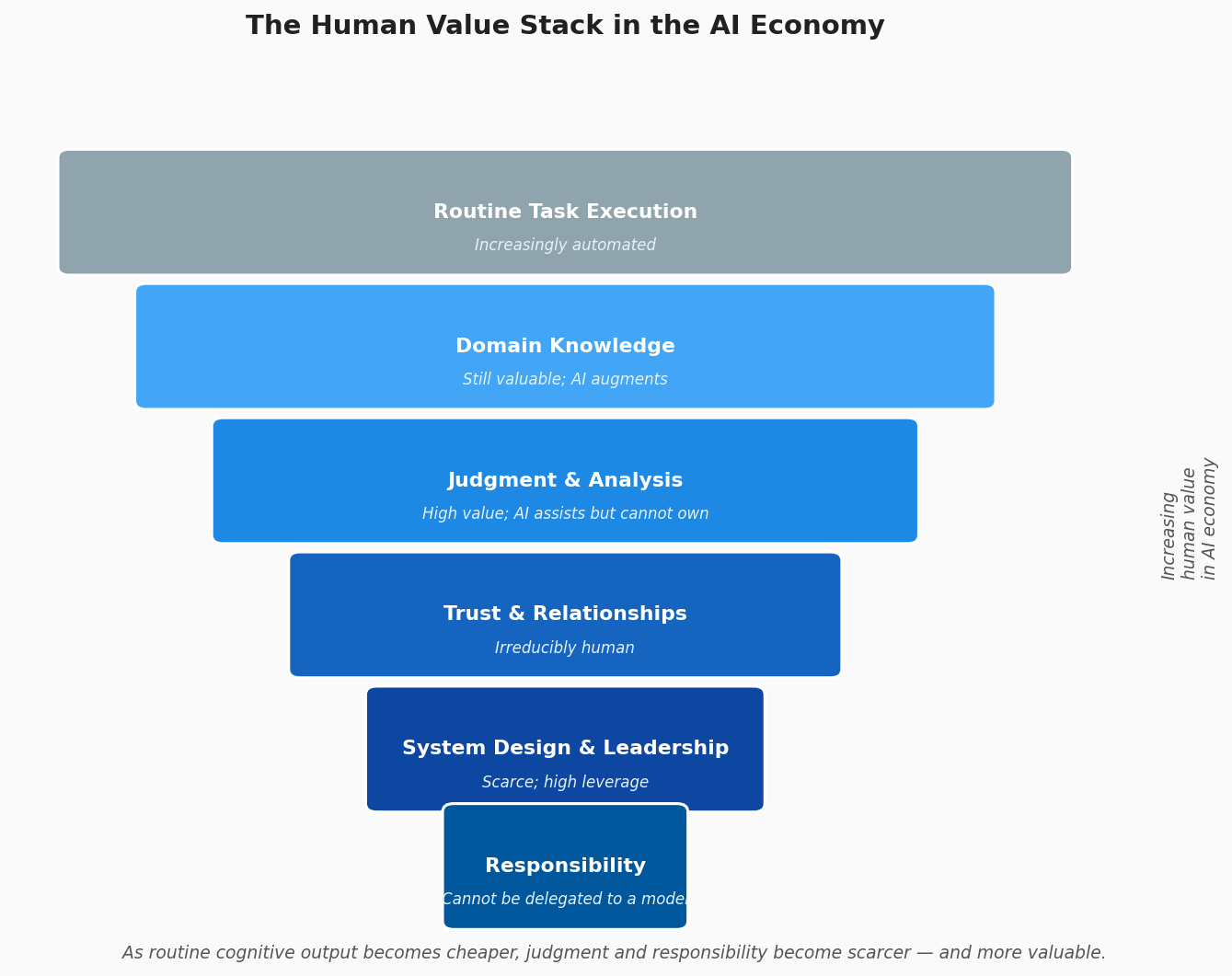
In finance, this distinction is particularly sharp. AI can summarize a 10-K, generate valuation assumptions, compare earnings calls, and screen thousands of firms in seconds. But it cannot fully replace the human responsibility of asking whether the assumptions make economic sense, whether the incentives are distorted, whether the data are misleading, and whether the decision is ethically defensible. AI can produce analysis. Human beings must still decide what the analysis means.
Don’t Fight for a Bigger Slice. Redesign the Bakery.
The most common way to talk about AI and labor is to ask whether humans or machines will get a bigger share of the existing economy. I think that is the wrong question.
The better question is: who learns to design the next economy?
If AI is deployed only as a cost-cutting tool — as a way to reduce headcount and expand margins — then the productivity gains flow primarily to capital owners and a small group of technical talent. That is a failure of design, not a law of nature. And it is a design that can be changed.
Because AI can also be something else entirely. It can help a first-generation student conduct research that previously required a lab full of people. It can help a small business owner serve customers the way only large companies used to. It can help a mid-career professional move from routine execution to higher-level judgment without spending a decade on a ladder that no longer exists. It lowers the cost of starting a company, building a prototype, and learning a new field.
The tools are extraordinary. What we build with them is up to us.
For students: the goal is not to learn how to get AI to produce outputs for you. The goal is to learn how to think alongside AI — to bring judgment, domain knowledge, and critical sense to what the model produces. That combination is rarer and more valuable than either alone.
For educators: our job is not just to teach skills. It is to redesign the apprenticeship — to find new ways to create the productive struggle through which real judgment is built, even as many traditional entry-level tasks have been automated.
For firms: if you automate away the bottom of the career ladder without creating new pathways, you will find yourself in five years with a shortage of senior talent and no pipeline to replace it. That is a business problem, not just an ethical one.
The optimistic case is not that AI automatically benefits everyone. The optimistic case is that we can design institutions, organizations, and educational systems that make it a tool for broader participation rather than narrower exclusion. That work is hard. It is also the most important work of the next decade.
What to Watch
The great decoupling is not a single event. It is a gradual restructuring, and the signals will come before the crisis does.
Watch entry-level hiring in AI-exposed occupations — if junior roles shrink while senior roles hold, the training ladder is weakening. Watch revenue per employee at leading AI firms — if growth stops creating proportional employment, the capital-labor relationship is structurally changing. Watch labor share of income — if productivity rises but workers capture less of it, the old contract is quietly dissolving. Watch task redesign inside jobs — the same job title can mean entirely different work; what roles actually require matters more than what they are called. Watch who owns the tools — if AI capability concentrates in a handful of firms, so do the gains.
None of these indicators points to catastrophe right now. All of them are worth watching carefully.
A Final Thought
The danger is not that humans become useless.
The danger is that we continue educating, managing, and valuing people as if the old contract were still intact — as if showing up, executing tasks reliably, and accumulating credentials were still sufficient for a life of security and meaning.
In the AI economy, the most valuable people will not be those who behave most like machines. They will be the ones who know what machines should be used for, what they cannot be trusted with, and what kind of society we are trying to build with them.
That is a harder and more interesting challenge than the one the previous generation faced. I think it is also a more human one.
References
- The core framing of capital-labor decoupling draws on a widely circulated commentary on structural economic shifts of the AI era.
- Anthropic. "Labor market impacts of AI: A new measure and early evidence." March 2026.
- Stanford HAI. The 2025 AI Index Report.
- McKinsey Global Institute. "Agents, robots, and us: Skill partnerships in the age of AI." November 2025.
- International Federation of Robotics. World Robotics 2025 Report.
- WIC Internet. "China leads global industrial robot market with record installations."
- NVIDIA fiscal year 2026 earnings. Revenue of $215.9 billion, up 65% year-over-year.
- OpenAI / Klarna. "Klarna's AI assistant does the work of 700 full-time agents."
- Amazon News. "Update from Amazon CEO Andy Jassy on Generative AI." 2025.
- Federal Reserve. "AI Adoption and Firms' Job-Posting Behavior." FEDS Notes, March 2026.
- Liberty Street Economics, Federal Reserve Bank of New York. "Do Job Postings Show Early Labor-Market Effects of AI?" May 2026.
- Wang, Wei, and Wang. "Generative AI and the Reorganization of Labor Demand." arXiv:2605.23159, 2026.